The Conversation (0)
iStockphoto by Getty Images
Researchers have discovered a new impact crater on the Moon’s surface - and it's surrounded by a mysterious cold spot.
The study titled “New lunar crater reveals extensive distal regolith modification” was published in Science Advances and it is believed by the team at Johns Hopkins University Applied Physics Laboratory that the spot first formed in Spring 2024, so it's relatively new.
They along with scientists from UCLA, Intuitive Machines, and NASA’s Jet Propulsion Laboratory (JPL) looked at images captured by NASA’s Lunar Reconnaissance Orbiter Camera (LROC) and this find means that they can improve their understanding on unexplained lunar cold spots that appear near new impact craters as well as the formation of the new lunar surface feature, also known as the McGetchin crater.
Size-wise, the lunar impact crater is approximately around 222 meters in diameter, but how often do craters this size appear on the Moon?
According to researchers crater production models, it is "an event of century-scale rarity" as predictions for craters like McGetchin happen once every 132 years on average.
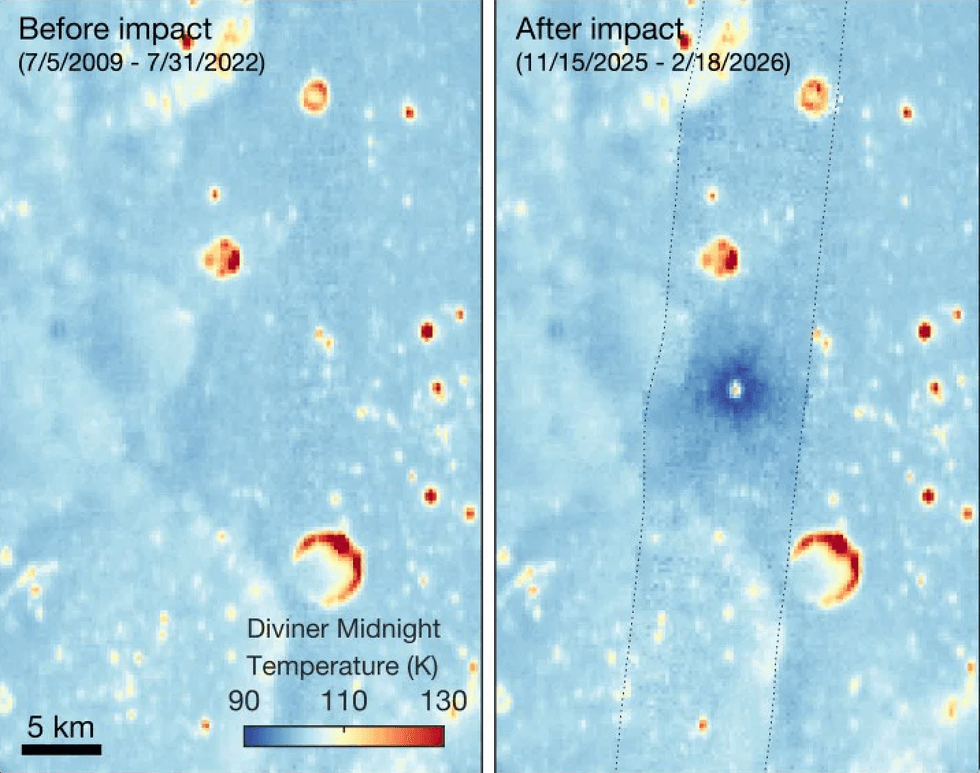 Before and after the impact reveal a ~7-km-wide “cold spot” around McGetchin crater. NASA/GSFC/UCLA/JHU APL.
This rare occurrence allows scientists to analyse the formation before “space weathering, impact gardening, and other surface processes" causes changes to the surface.
"Discovered in repeat Lunar Reconnaissance Orbiter Camera images, it provides a unique opportunity to study surface modification by a pristine impact, prior to subsequent fading,” they explained.
What's more, it discovery gives researchers "the best opportunity yet to observe a large, virtually unaltered cold spot with well-characterized pre-impact conditions.”
Cold spots are located around fresh impact craters and are "extensive regions of reduced nighttime temperature relative to surrounding terrain that have been observed around young impact craters between ∼30 m and ∼2 km in diameter," noted the team and were first found in nighttime temperature data from the LRO’s Diviner Lunar Radiometer.
So how big are the cold spots? Well, they are actually much bigger than the actual craters themselves, in fact they reach “tens to, in some cases, hundreds of crater radii."
There are a number of theories as to why these cold spots exist, the most popular one being that they are a result of a “decompaction” of the upper layer of regolith during the impact event.
“Thermal modeling shows that the observed nighttime cooling is consistent with reduced density in the upper centimeters of the regolith, resulting in lower thermal inertia,” they explained.
Measurements taken on the Apollo 16 mission landed on a ‘faint’ cold spot appear to support this theory, as footprints left by astronauts n the South Bay cold spot were measurably deeper than similar prints at other lunar landing sites.
As for how long cold spots last, they fade slowly - “on ∼100 ka to ∼2 Ma timescales" to be more precise, making them reliable dating markers for impact craters on the Moon.
Being able to discover young lunar impact craters “has enabled their use in investigations of regolith thickness, the recent impact cratering rate, and as potential source craters for lunar meteorites.”
“This will improve our understanding of cold spot formation and provide a calibration for the fading timescale of cold spots, potentially enabling age estimates for some of the youngest craters on the Moon using cold spot properties,” they explained.
Why not read...
- Part of the sun is 'broken' and it's left scientists with one question
- The Moon is shrinking and scientists are starting to get concerned
Sign up to our free indy100 weekly newsletter
Have your say in our news democracy. Click the upvote icon at the top of the page to help raise this article through the indy100 rankings.
Top 100