The Conversation (0)
Iran war: Pentagon seeks another $80B from Congress
Fox - Fox 9 / VideoElephant
The Pentagon has informed senators it requires approximately \$80 billion, primarily to fund the United States’ ongoing war against Iran. This substantial sum would be in addition to the significant military spending increase already being sought by President Donald Trump.
While the White House Office of Management and Budget has yet to submit a formal request to Congress, Defense Secretary Pete Hegseth has been actively lobbying on Capitol Hill, including meetings held on Monday evening. A senior deputy defence secretary reportedly briefed senators on the Iran funding request last week, according to two individuals familiar with the situation who were not authorised to speak publicly. These developments were initially reported by The Wall Street Journal.
The push for billions of dollars in war funding arrives at a tense political moment. Lawmakers remain sceptical of the agreement Donald Trump reached with Iran to end the conflict and are apprehensive about future actions. The White House has already requested a staggering \$1.5 trillion for the Pentagon – a nearly 50 per cent increase over current fiscal year funding levels.
Senate Majority Leader John Thune indicated he anticipates a supplemental spending request from the administration for the war. Upon its arrival, he stated, "We’ll work through it and see where the votes are."
"We need to make sure we’re doing everything we can to replenish and resupply a lot of our munitions that have been depleted — not only just with what’s happening with Iran, but prior to that," said Mr Thune, a Republican from South Dakota.
Deputy Defence Secretary Stephen Feinberg discussed the proposal with several senators in calls last week and notified congressional committees that the $80 billion request had been sent to the Office of Management and Budget. The Pentagon did not immediately respond to a request for comment.
However, the proposed funding package is almost certain to face significant opposition from lawmakers who refuse to support President Trump's decision to go to war and are reluctant to grant the Pentagon more money at a time of soaring cost of living for ordinary Americans.
"You’re spending families’ hard-earned tax dollars on a war that many strongly oppose," Democratic Senator Patty Murray told Mr Hegseth during a hearing last month.
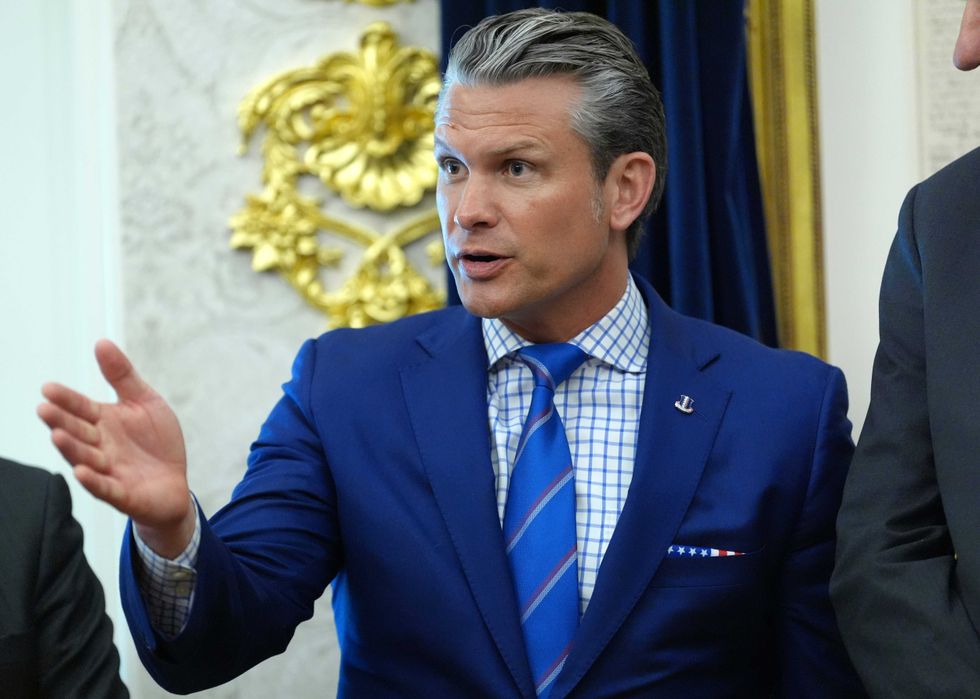 Defense Secretary Pete Hegseth speaks in the Oval Office of the White House during an executive order signing about quantum computing with President Donald TrumpAP Photo/Jacquelyn Martin
Beyond the Iran funding, Republicans aim to secure approximately $1 trillion through the standard appropriations process, which typically requires bipartisan support. They then hope to secure an additional $350 billion through a largely partisan vote later this summer.
The amount now being sought by the Pentagon is considerably higher than the $29 billion estimate of war costs Mr Hegseth provided to Congress during his testimony last month. The bulk of that earlier figure related to replacing ordnance and repairing equipment, alongside operational expenses for deployed forces. That estimate did not include the cost to repair or rebuild US military sites damaged in the region.
It is also significantly lower than the initial $200 billion the Pentagon floated as the cost at the start of the war. An early estimate had placed the cost of the first week of the conflict at $11.3 billion.
Senator Brian Schatz of Hawaii, a member of Democratic party leadership, suggested the actual price tag could be much higher than the \$80 billion currently proposed.
Mr Schatz stated he had not counted Democrats regarding support for an Iran-focused bill, "but I haven't found anyone who wants to do this."
Conversely, Republican Senator Jim Banks of Indiana remarked, "To me it’s less about the war, it’s more about the stockpiles."
Mr Banks added, "I would sell it to my state as an investment in our defense industrial base, reshoring defense production to Indiana."
Senator Jack Reed, the top Democrat on the Senate Armed Services Committee, argued that funding for an Iran supplemental cannot be done in isolation. He believes it must follow an agreement between lawmakers from both parties on a total spending amount for both defence and non-defence programmes, after which "the rest of this would follow pretty quickly," Mr Reed said.
Senator John Hoeven of North Dakota, a member of the Appropriations subcommittee on Defence, confirmed he has been working with the administration to broaden the package to include funds for disaster aid for California, Hawaii, and other states severely affected by fires and adverse weather, as well as agricultural aid for farmers.
"I think that’s the kind of combination that could pass," Mr Hoeven commented.
Mr Hegseth declined to answer questions from reporters late Monday as he walked through the Capitol.
However, on the issue of the war's cost, Mr Hegseth posed a rhetorical question during a Senate hearing last month, asking, "What is the cost of Iran obtaining a nuclear weapon?"
He acknowledged that the President's decision to confront the threat of a nuclear Iran "comes with cost — and we recognize that."
Top 100