The Conversation (0)
Science & Tech
For the first time, scientists have precisely measured the instantaneous, mind-boggling power of jets erupting from a black hole, revealing an energy output equivalent to 10,000 suns. An international research team reported that these powerful jets, observed in a relatively nearby black hole-star system, travel at approximately 540 million kilometres per hour – half the speed of light.
The focus of this groundbreaking study is Cygnus X-1, located 7,200 light-years away. This system is notable not only for being the first black hole ever identified over half a century ago, but also for its constant companion, a blue supergiant star. A single light-year spans nearly 9.7 trillion kilometres.
The findings, published in Nature Astronomy, are the culmination of 18 years of high-resolution radio imaging gathered by a global telescope network. Dr Steve Prabu, from the University of Oxford, who conducted the research while at Australia’s Curtin University, led the team. They were able to measure the swift power of these "dancing jets", as Dr Prabu describes them, as they were pushed in opposing directions by the star’s stellar wind. Their calculations relied on how much the jets were bent by this wind, alongside sophisticated computer modelling.
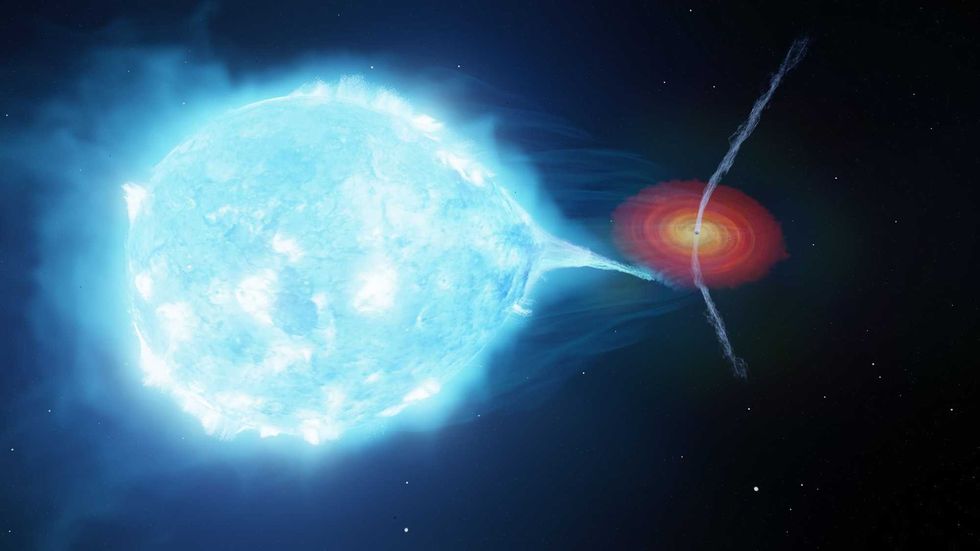 A strong stellar wind from the supergiant star pushes the jets launched by the black hole away from the star. ICRAR via AP)
Previously, the power of a black hole’s jets could only be estimated by averaging data over tens of thousands of years. A key discovery from this research is that 10 per cent of all the energy released as matter falls towards the black hole is subsequently carried away by these jets.
The black hole in Cygnus X-1, considered modest in size, continuously draws gases from its stellar partner as they orbit each other. Discovered in the 1960s, this binary system resides within our Milky Way’s Cygnus, or swan, constellation. Dr Prabu explained that the supergiant star provides the black hole with "something to ‘eat’ and launch as jets".
These observations are crucial for scientists seeking to understand how black holes influence the formation and evolution of galaxies and other cosmic structures through large-scale shocks and turbulence. Dr Prabu intends to apply these innovative techniques to investigate other black holes, stating, "It would be exciting to measure jet power in many more systems."