The Conversation (0)
The Science Behind Why The Pyramids Survived Earthquakes
XPLNR - Vertical / VideoElephant
The mystery of how Egypt’s Great Pyramid was built may finally be solved.
For decades, experts have struggled to explain how ancient workers lifted and positioned millions of huge stone blocks - some weighing up to 15 tons - without modern machinery. No written records reveal how they did it.
Are we close to the cracking the mystery of Egypt’s Great Pyramid?
Possibly, according to a new study which outlines how hidden spiral ramp running inside the Pyramid of Khufu may have helped to built the structure.
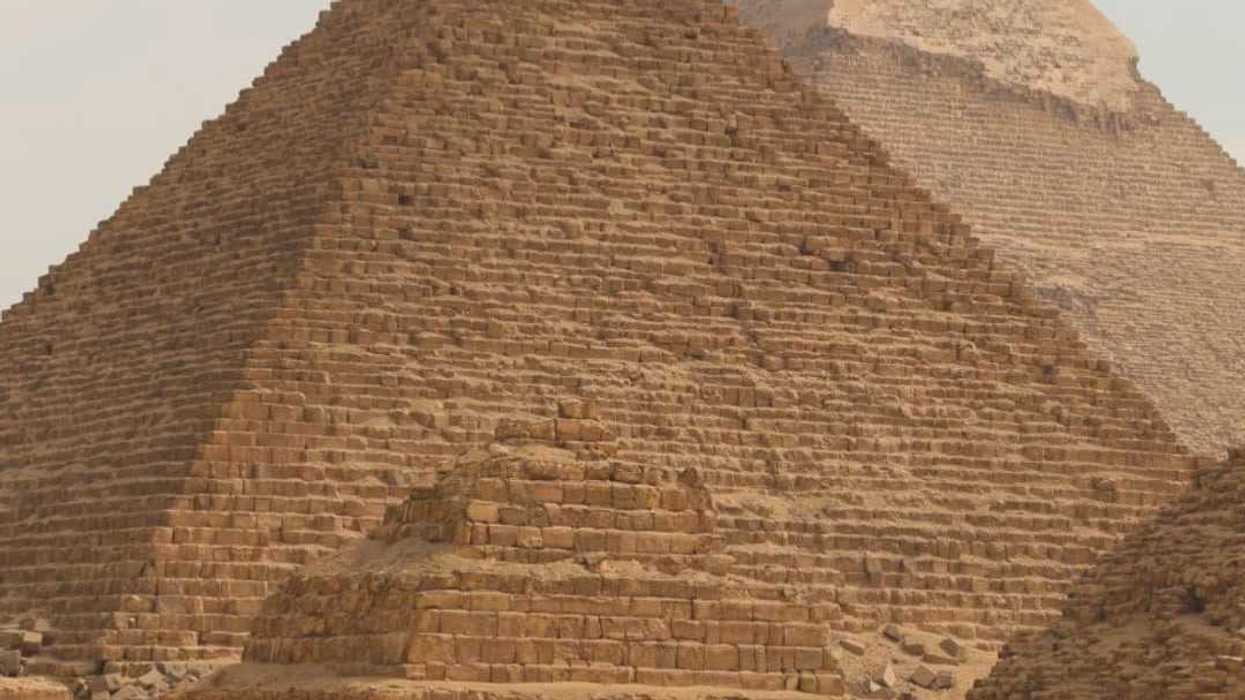
More specifically, that an 'edge ramp' was used by workers, this would mean on the pyramid's outer edges there would've been a a sloping path for each new layer added, it would inevitably cover this path, according to Computer scientist Vicente Luis Rosell Roig.
 iStock
So why would this method have been used? It would've meant that huge external ramps weren't needed and instead enabled the stones to move gradually at each level by the workers.
It's a pretty nifty method given the scale of the whole thing. For context, the pyramid is a whopping 481 feet in height and 755 feet along each side of its base, and ultimately built with roughly 2.3 million stone blocks, according to historians.
We're tired just thinking about it.
With this hidden ramp, how long would've it have taken to finish building this monument? To determine this, simulations were undertaken and suggest the blocks would've been placed pretty consistently, we're talking around every four to six minutes.
At that rate, the completion time for the pyramid would've been around 14 to 21 years.
But let's be realistic, there are other additional factors at play that need to be considered such as quarrying, transportation and workers breaks.
With these in mind, the estimate gets bumped up to around 20 to 27 years, and this number in line with existing estimates.
The hidden ramp could also play a key part in solving the mystery behind the empty spaces have been detected inside the pyramid as parts of the hidden ramp could still remain.
"Old Kingdom technology precluded iron tools, wheeled heavy transport, and compound pulleys, but allowed copper chisels, water-lubricated sledges, ropes, levers, earthen works, and Nile barges,' Rosell Roig said in a study in NPJ Heritage Science, published in March 2026.
"Accordingly, we bound ramp slope, lane width/clearance, and friction, and evaluate the dispatch headway (time between placing successive blocks) required to satisfy the 20–27-year window, encoding these constraints as model parameters."
That being said, question still remain in regards to how builders back then logistically were able complete these impressive and precise builds with huge materials but with limited technology.
Why not read...
- ‘World’s oldest pyramid' was not made by humans, archaeologists claim
- Archaeologists discover the lost 'Book of the Dead'
Sign up to our free indy100 weekly newsletter
Have your say in our news democracy. Click the upvote icon at the top of the page to help raise this article through the indy100 rankings.
Top 100