The Conversation (0)
Science & Tech
Antarctica is a continent best known for its snowy, ice-covered landscape, but researchers have discovered dark volcanic peaks in the Hudson Mountains.
There, they have found pink granite boulders which stand out against the surroundings of dark volcanic rock have also revealed something else.
A vast buried granite body almost 100 km across and 7 km thick - to put this in perspective, that's about half the size of Wales in the UK.
But the question is, when exactly did these form?
That's what scientists led by the British Antarctic Survey (BAS) have been researching and were able to uncover this information as to where the material originated from by studying the radioactive decay of elements locked within microscopic crystals.
Researchers say the rocks formed during the Jurassic period, around 175 million years ago, as per the study published in Nature Communications Earth & Environment last October.
As to how the boulders ended up in these mountains has been a mystery, until now.
BAS' Twin Otter, along with aircraft surveys of the region, managed to uncover variations in gravitational pull around the southern Hudson Mountains, an anomaly which suggested something deep beneath the mountain's Pine Island Glacier - and this turned out to be the buried granite.
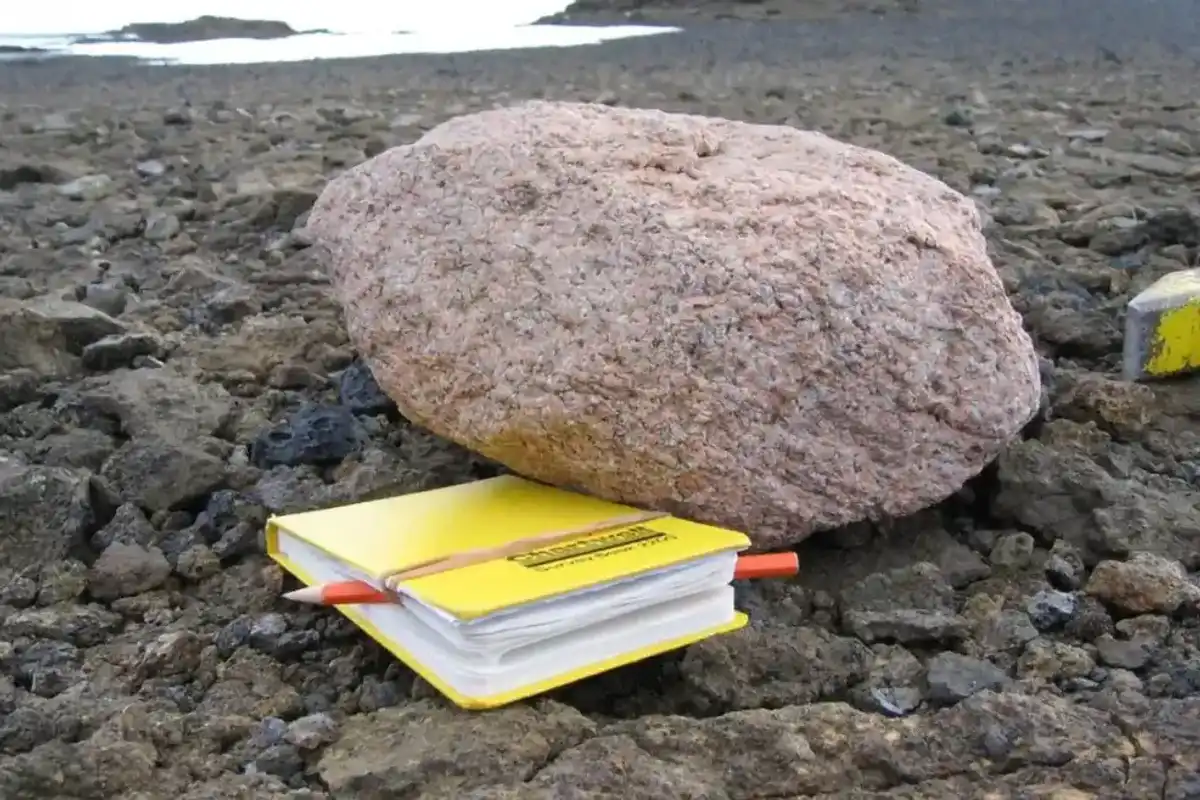 Jo Johnson / BAS
The BAS described the link between the scattered boulders and massive hidden granite as a "breakthrough", as it has provided further understanding of the past on the Pine Island Glacier, where rocks were plucked from the bed and dropped on the mountains when the ice sheet was thicker.
Experts need to chart the flow and thickness of the ice during the last ice age (around 20 thousand years ago) so that ice sheet computer models can be more accurate, a vital part of predicting how rising sea levels caused by climate change could impact the continent in the future - especially since Pine Island Glacier, has seen some of the fastest ice loss in Antarctica in the last few decades.
“It’s remarkable that pink granite boulders spotted on the surface have led us to a hidden giant beneath the ice," said Dr Tom Jordan, lead author and geophysicist at BAS, who analysed the airborne survey data.
"By combining geological dating with gravity surveys, we’ve not only solved a mystery about where these rocks came from, but also uncovered new information about how the ice sheet flowed in the past and how it might change in the future."
Elsewhere from Indy100, Antarctica’s Egypt-like 'pyramid' is sparking conspiracy theories around an ancient civilisation, and Giant underwater mountain and 100 new species discovered in 'mind-blowing' expedition
How to join the indy100's free WhatsApp channel
Sign up to our free indy100 weekly newsletter
Have your say in our news democracy. Click the upvote icon at the top of the page to help raise this article through the indy100 rankings.