The Conversation (0)
'Manosphere' influencers prey on the insecurities of young men, expert says
FMM - F24 Video Clips / VideoElephant
Once a fringe online subculture, the 'manosphere' – a controversial network focused on masculinity, dating, and gender politics – has entered mainstream culture.
Sometimes disguised as 'self improvement' or so-called 'hard truths,' many of these spaces promote 'Red Pill' ideology, which holds that society is rigged against men and that women are ultimately untrustworthy, manipulative, and hypergamous – favouring partners with higher social or economic standing.
Ofcom, the UK-based watchdog, found that manosphere content often blends motivational language with hostility toward women, making it easier for harmful ideas to spread unnoticed. Algorithms on platforms such as TikTok, Reddit, Instagram and YouTube frequently amplify this material, pulling users deeper into gender-polarised echo chambers.
The belief has become so culturally embedded that mainstream entertainment, including Adolescence, has been forced to engage with it, drawing attention to narratives circulating across online manosphere spaces.
The phenomenon stretches far beyond television shows or exaggerated online personas. It exists offline, in real life, and among real men. Most often, it takes hold of younger boys searching for direction and belonging – though older men are not immune to its pull.
According to Educate Against Hate, individuals who are drawn to this type of content tend to fall into four predominant manosphere groups and often exhibit a poor sense of self alongside negative perceptions of others.
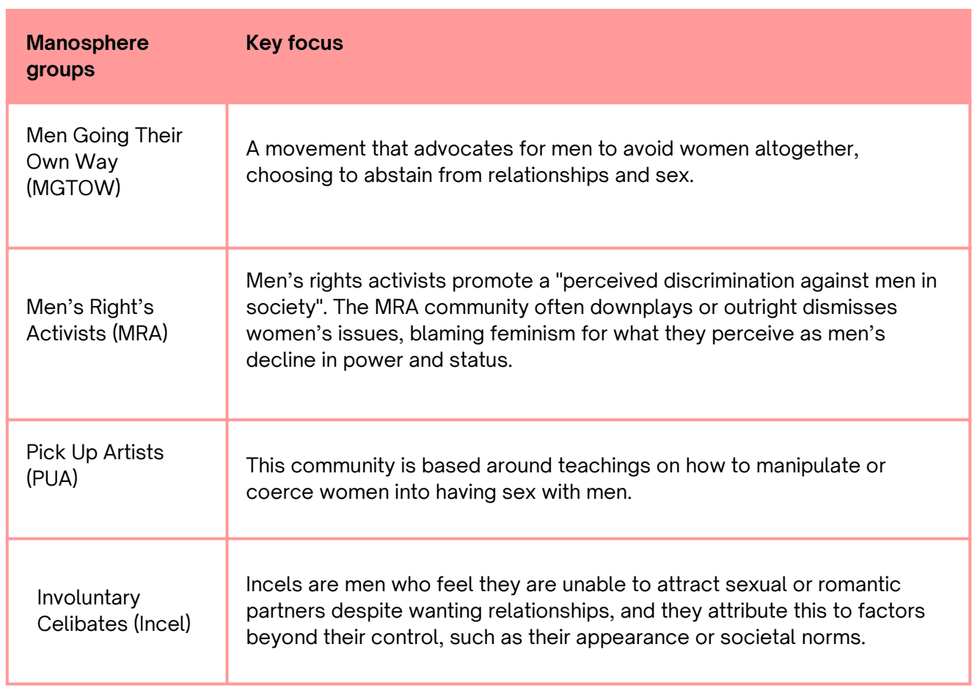 Educate Against Hate
The ideas driving these spaces have long been scrutinised by academic research, which shows that claims around female hypergamy and dating hierarchies are often misrepresented and not supported by real-world relationship data.
In recent months, public figures have also pushed back. Supermodel David Gandy, for instance, criticised the "immature" and "disruptive" narrative of masculinity, arguing that young boys are being failed by the absence of healthy male role models.
When those figures are missing, something murky fills the gap: online personalities offering rigid answers and emotional validation, often promoting questionable values, but making followers feel seen, heard, and understood.
For many, that sense of recognition is what turns curiosity into loyalty.
Although manosphere spaces vary from platform to platform, their most dominant themes are strikingly consistent: misogyny, emotional isolation, and a gradual radicalisation that normalises hostility towards women and frames relationships as adversarial rather than mutual. While older generations may dismiss it as internet noise, the consequences are playing out in real life, in real time, in behaviours that are far from harmless – particularly against women.
At the same time, young men are also being harmed by the very content they consume. A Movember study found that young men who regularly engage with "masculinity" influencers report significantly higher levels of worthlessness, nervousness, and sadness.
These spaces can also funnel users into extreme subcultures such as looksmaxxing, where self-worth becomes tied to rigid physical ideals, often encouraging obsessive and harmful behaviours.
 iStock
Fortunately, not everyone who enters these spaces remains trapped within them. Many leave after witnessing first-hand the harms they cause and recognising the underlying motives at play – particularly the way male vulnerability and loneliness are exploited and monetised for profit.
To understand how these ideas move from abstract belief systems into lived reality, it is necessary to hear from those who once subscribed to them. Through their stories, they reflect on what initially drew them in, what made them question those beliefs, and what it took to leave – revealing how shame, empathy, and self-reflection can break such cycles of resentment that online culture often reinforces.
Alexandre, 21, was born in Portugal and raised in the United States from the age of 11. He believes his first involvement in manosphere content was rooted in his religious background as an Evangelical Christian, telling Indy100 it was how he justified most of his beliefs.
While online communities normalise the type of views and commentaries, it took Alexandre to express similar views outside of the niche communities to realise they weren't as reciprocated offline as they were online.
He describes feeling deeply "uncomfortable, as though I wasn't acting in alignment with who I truly am," after realising the views he held as a result of these online communities were rooted in "hatred, resentment, jealousy and shame".
"I still remember, to this day, the almost tangible amount of shame I felt when I realised how lame it was to be acting the way I was – that I had hatred for women because I felt as if they had rejected me before I even tried," he shares.
He now urges people to consider why the content exists, and ultimately, who is actually benefiting from it.
"It most certainly is not helping the person consuming it, but there are people who are making millions of dollars fueling their hatred of women," he shares. His experience reflects a wider ecosystem in which influencers profit by offering certainty and validation, while leaving followers more isolated than before.
These communities exploit loneliness, offering the illusion of understanding while deepening isolation and reinforcing hostility toward women.
That's exactly what happened to Jemal, a 23-year-old from Barbados, who found himself spending a lot of time online and confessed "screen addiction" during the pandemic.
At first, like for many, the type of content portrayed itself as self-improvement, with Jemal admitting that it felt motivating at first – especially when the world around had come to a pause.
He was initially drawn to the recurring themes of "discipline, achievements, and 'measuring worth' through tangible success," but he soon came to be "frustrated" when he realised how unrealistically and unachievably high the standards were for those fresh out of school or college.
It's worth noting that some men leading these spaces are almost twice their age.
 iStock
Jemal then started picking up on damaging patterns, filled with "misleading content and spreading hate with little accountability".
"I noticed a lot of users defending ideas or people without fully understanding the context or what those people actually represented, and being outspoken often meant not listening to criticism," he shares. "Once someone picked a side, it was hard to see the other perspective and that made it easy to get stuck in the cycle of resentment".
A lot of these spaces push out lazy AI-generated content too, which is a whole other matter. But Jemal soon picked up on the way gender roles were presented in such clips, in that the protagonist was always a man being betrayed by an "evil" woman.
"I initially treated these AI videos as background entertainment, but reading the comments was concerning," he says, citing horrific generalisations of women based on something created by a bot.
Those engaging negatively with the content, as Jemal describes, were "celebrating this kind of hatred" – and he no longer recognised himself as a part of that community.
"I no longer wanted to represent their worldview nor be represented by them. Something about the deep-seated resentment and generalisation was clearly wrong, and I knew I needed to step away," he shares.
Instead, Jemal distanced himself from the narrow-minded thinking of the manosphere and reflected on the "sad" creators he once admired.
"I realised I wanted to work on myself in a more honest way to actually know who I am, rather than chasing an identity prescribed by people online," he notes.
Jemal also credits the "amazing women" in his life, and how a viral TikTok trend really hit home: Man vs Bear.
In 2024, women were posed a seemingly harmless question: would they rather be alone in a forest with a man or a bear? The overwhelming number of women who chose the bear sparked widespread debate, think pieces and online discourse – and, for Jemal, a moment of reflection.
"It made me want a better world, one where women don’t have to fear men, and where men don’t justify hating women," he shares. "I want a world where safety is the norm, not something granted by certain men. That might sound idealistic, but I believe change can start small, like every great movement within friend groups, communities, cities and expand outward".
He initially saw online gender dynamics as a "petty gender war", rooted in personal grievances such as break-ups or betrayals. Acknowledging the limits of that male-centric view, he began asking female friends and family about their experiences, which he describes as "eye-opening".
"Their experiences made it clear that women face challenges and fears that are often invisible to men who imagine everyone sees the world as they see it," he adds, noting that these conversations helped him begin to undo some of the negative impact the manosphere had on his mindset.
Choosing to leave the manosphere is rarely a sudden rejection of masculinity itself, but a quiet unlearning of the resentment wrapped around it.
For those who feel trapped inside these spaces, escape often begins not with certainty, but with doubt – a moment of discomfort when the anger no longer feels empowering, or when the promises stop delivering relief.
The stories of those who leave show that meaning, confidence, and connection are not found in rigid hierarchies or blame, but in curiosity, accountability, and human empathy.
There is a way out – and it does not require abandoning yourself, only refusing to let your loneliness be weaponised against you.
"Just know that you are enough as you are," Jemal shares, advising men to step outside – not just in reality, but from these toxic online spaces. "You don’t need universal approval to have worth, and you don’t need to earn your right to be loved through constant achievement or validation."
"A society that resents an entire gender will eventually collapse, because that resentment corrodes everyone involved," he concludes. "It is up to us men and women alike to recognise the good in each other and not let the actions of a few define the whole".
It can be really hard to ask for help, but talking to someone can make a real difference. The following UK support services offer confidential listening, emotional support, and peer connection:
- Samaritans: Free, 24/7 emotional support for anyone struggling to cope. Call 116 123.
- Shout: Free, confidential 24/7 text crisis support. Text SHOUT to 85258.
Top 100