
The Conversation (0)
Egypt: Visitors watch sun align with ancient Luxor temple on winter solstice
Africanews - News / VideoElephant
Our understanding of ancient Egyptian technology has evolved thanks to experts reevaluating a small metal object.
Researchers from Newcastle University and the Academy of Fine Arts in Vienna have had another look at the small copper-alloy object excavated a century ago from a cemetery at Badari in Upper Egypt.
In their analysis, they concluded that the object was the earliest identified rotary metal drill from ancient Egypt.
(Around the Predynastic period (late 4th millennium BCE) to be exact, before the first pharaohs ruled.)
When was the object first discovered?
 public domain
The artefact was initially excavated back in the 1920s from a cemetery at Badari and has since been stored in the Museum of Archaeology and Anthropology at the University of Cambridge.
At just 63 millimetres long and weighing around 1.5 grams - it was described as “a little awl of copper, with some leather thong wound round it.”
The object was overlooked in the decades that followed, until now, as researchers put it under magnification, where they found "distinctive wear consistent with drilling: fine striations, rounded edges, and a slight curvature at the working end, all features that point to rotary motion, not simple puncturing."
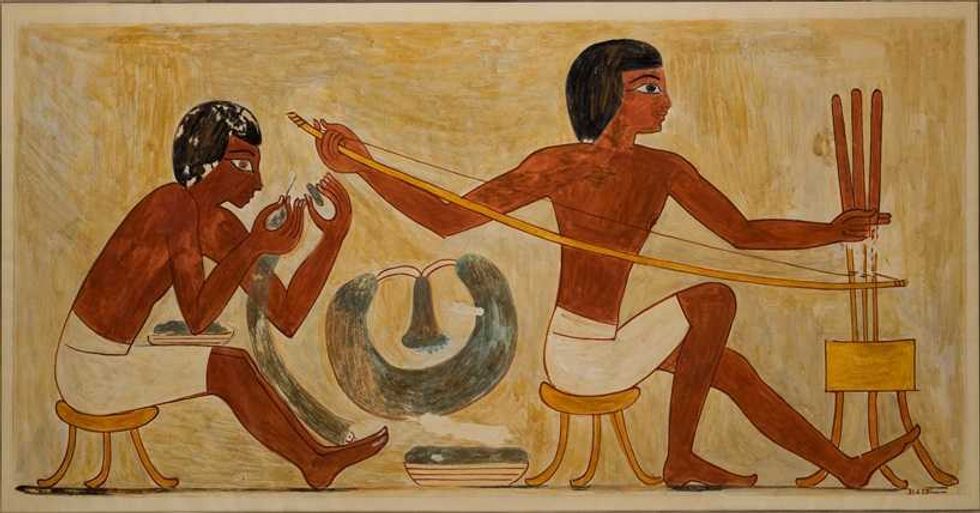
In addition, experts also noted the six coils of an extremely fragile leather wrapped around the object and is believed to be a remnant of the bowstring used to power a bow drill. Essentially, this is an ancient version of a hand drill, where a string wrapped around a shaft is moved back and forth by a bow to spin the drill rapidly.
As a result, this technique enables faster and more controlled drilling in comparison to simply pushing or twisting by hand.
For context, Bow drills are well known from later periods of Egyptian history, and so this discovery implies that the technology was around over two thousand years earlier than previously thought.
What did the experts say?
"The ancient Egyptians are famous for stone temples, painted tombs, and dazzling jewellery, but behind those achievements lay practical, everyday technologies that rarely survive in the archaeological record. One of the most important was the drill: a tool used to pierce wood, stone, and beads, enabling everything from furniture-making to ornament production," said Dr Martin Odler, Visiting Fellow in Newcastle University’s School of History, Classics and Archaeology and lead author.
“This re-analysis has provided strong evidence that this object was used as a bow drill – which would have produced a faster, more controlled drilling action than simply pushing or twisting an awl-like tool by hand. This suggests that Egyptian craftspeople mastered reliable rotary drilling more than two millennia before some of the best-preserved drill sets.”
The team also carried out chemical testing using portable X-ray fluorescence (pXRF), found the drill was made from an unusual copper alloy.
Co-author Jiří Kmošek explained: “The drill contains arsenic and nickel, with notable amounts of lead and silver. Such a recipe would have produced a harder, and visually distinctive, metal compared with standard copper. The presence of silver and lead may hint at deliberate alloying choices and, potentially, wider networks of materials or know-how linking Egypt to the broader ancient Eastern Mediterranean in the fourth millennium BCE."
It just goes to show how big discoveries can still be made from objects within museum collections.
Elsewhere from Indy100, Ancient Egyptians used ‘volcano fashion’ to build pyramids, and Mysterious structures unearthed beside the Great Pyramid of Giza.
How to join the indy100's free WhatsApp channel
Sign up to our free indy100 weekly newsletter
Have your say in our news democracy. Click the upvote icon at the top of the page to help raise this article through the indy100 rankings.
Top 100