The Conversation (0)
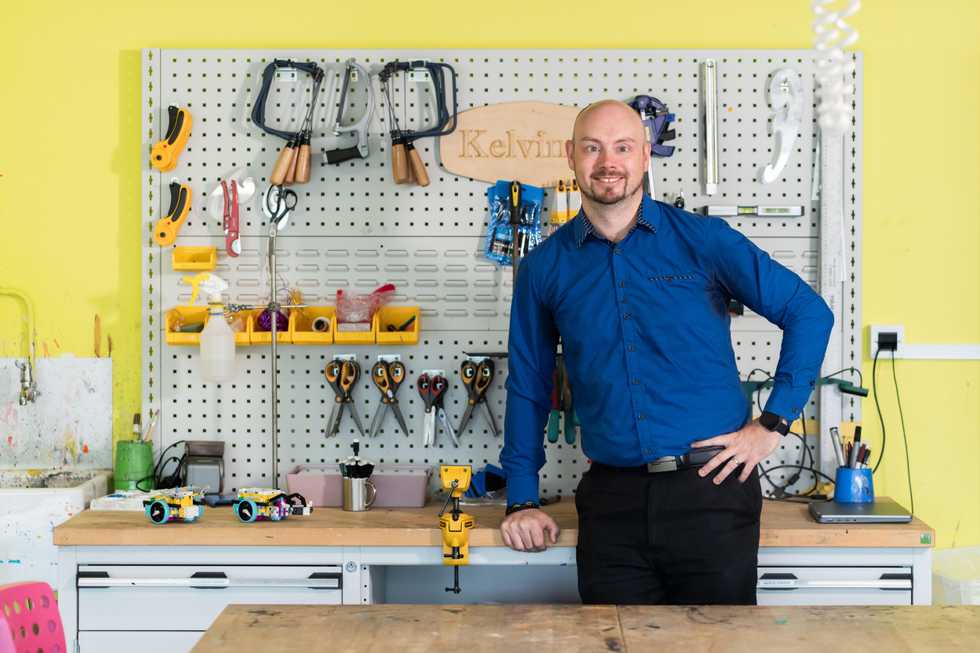
Stuart Naismith said a cycling accident 11 years ago was a ‘turning point’ that led to him becoming a science educator (Kelvinside Academy/PA)
A Glasgow teacher awarded one of the most prestigious honours in British science has revealed how a cycling accident that left him with lifelong injuries sparked a “remarkable” career change.
Stuart Naismith was working in vehicle finance when he was struck by a car while cycling home from work in Glasgow about 11 years ago.
The collision left him with injuries to his shoulder, spine and coccyx, as well as permanent hip damage and chronic pain.
Sometimes one question, one mentor or one unexpected turning point can set you on an entirely different path
Stuart Naismith
He returned to work on crutches, but the experience made him reconsider his future and train as a primary school teacher.
That decision resulted in a “remarkable” journey into science education that in August saw the 39-year-old awarded the 2026 Royal Society Hauksbee Award.
Despite having no formal science background, Mr Naismith has also built an international audience through his free Stem with Mr N project.
His science videos have recorded more than 500,000 views on YouTube and 5.5 million on TikTok, while resource packs have been distributed to about 900 teachers in 69 countries, with a potential reach of more than 330,000 pupils.
One TikTok video, in which an air-pressure experiment failed and covered him in red liquid during a school assembly, attracted 2.4 million views.
Mr Naismith has now joined Kelvinside Academy in Glasgow as its new teacher of innovation, leading hands-on projects for every junior school year and two S1 classes.
 Stem with Mr N began as a way of providing science activities to primary pupils learning at home during the Covid pandemic (Dominic Lipinski/PA)PA Media - Dominic Lipinski
“The accident was a turning point,” he said.
“I had expected to continue working in business, but it forced me to think seriously about whether that was what I wanted to do with my life.
“I had considered teaching when I was younger, so I applied for the postgraduate primary education course at the University of the West of Scotland.
“I had no idea it would eventually lead to science, never mind an award from the Royal Society.”
The Hauksbee Award recognises outstanding scientific contributions by people whose work is often performed behind the scenes or in support of others.
His interest in Stem (science, technology, engineering and mathematics) began during his teacher training, when he asked his science lecturer why the world stopped appearing yellow after he had worn tinted cycling glasses for a period of time.
She returned with an explanation of how his brain was correcting the colour, but had also recognised something important in the question.
“She noticed that I seemed curious – and that stood out to her. That one observation changed everything,” Mr Naismith explained.
“You do not need to know every answer, but you do need the curiosity to ask the question.
“I hope people hear my story and realise they do not always need conventional qualifications or a lifelong plan to pursue a passion.
“Sometimes one question, one mentor or one unexpected turning point can set you on an entirely different path.”
Talent and potential are not always revealed through a conventional route
Dan Wyatt, rector of Kelvinside Academy
Stem with Mr N began during the Covid pandemic, when Mr Naismith was asked to provide science activities for primary pupils learning at home.
He filmed inexpensive experiments while caring for his newborn son during the day and edited the videos at night.
Six years on the project is still going strong, with experiments ranging from air-pressure water fountains to making a simple sundial.
His Stem Career Interviews, which introduce pupils to the opportunities available in science, have also featured guests including former Nasa astronaut Nicole Stott, forensic anthropologist Professor Dame Sue Black, and palaeontologist and Jurassic World scientific adviser Professor Steve Brusatte.
“The aim is always to explain the ‘how’, rather than simply deliver the ‘wow’,” the teacher said.
“An experiment might catch a child’s attention, but the value comes from helping them understand why it happened and what they could investigate next.”
He added: “Looking up an answer has never been easier, but finding an answer is not the same as understanding it.
“I want pupils to consider what they know, develop an idea, test it and decide whether the evidence supports it.
“AI is a powerful tool, but it is not infallible, while social media can present something as fact simply because somebody says it confidently.”
Dan Wyatt, rector of Kelvinside Academy, said: “Stuart’s route into science education is remarkable, but it also carries an important message for our pupils.
“Talent and potential are not always revealed through a conventional route.
“His ability to turn curiosity into practical learning aligns perfectly with our Innovation School.
“He will encourage pupils to question, create and test ideas while developing the confidence to keep working when the first solution does not succeed.”
Top 100