The Conversation (0)
NASA warns that Earth is defenceless against killer asteroids
Bang Showbiz - Bang Bizarre / VideoElephant
Scientists have successfully altered an asteroid’s path around the sun for the first time, a breakthrough that could prove vital in diverting a potentially hazardous space rock from impacting Earth in the future. The findings, reported on Friday, confirm that the asteroid targeted by NASA’s DART spacecraft was nudged into a slightly different solar orbit, despite never posing a threat to our planet.
"This study marks a notable step forward in our ability to prevent future asteroid impacts on Earth," the international research team wrote in Science Advances.
The changes observed were subtle, amounting to a reduction of just one-tenth of a second and 720 metres to a solar lap that spans two years and hundreds of millions of kilometres. However, experts stress the profound significance of these seemingly minor adjustments.
"Even though this seems small, a tiny deflection ... can add up over decades and make the difference between a potentially hazardous asteroid hitting or missing the Earth in the future," explained lead author Rahil Makadia, from the University of Illinois Urbana-Champaign.
He added that for any planet-saving tests, "the key isn’t delivering a huge shove at the last minute. The key is delivering a tiny shove many years in advance."
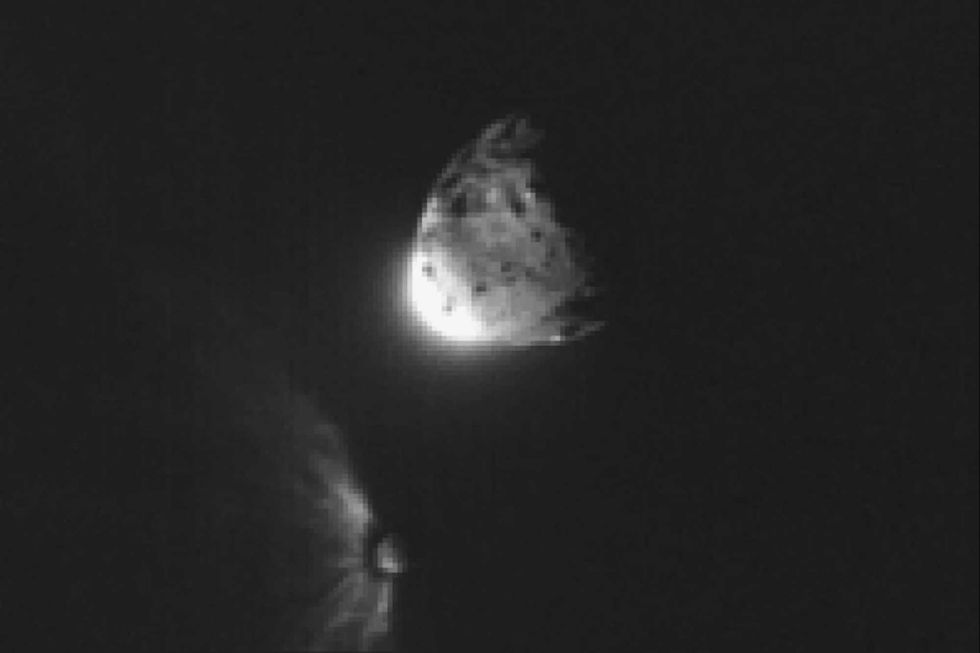 An impact plume emerges from the asteroid Dimorphos, left, after DART collided into it,NASA/ASI/University of Maryland/Tony Farnham/Nathan Marder via AP
The DART spacecraft, launched in 2021 as part of the world’s inaugural planetary defence exercise, deliberately collided with Dimorphos, a smaller asteroid orbiting a larger companion, Didymos, as they journey together around the sun. While NASA quickly confirmed the 2022 strike had trimmed Dimorphos’s orbit around Didymos, it has taken until now for scientists, using global observations, to confirm the impact also cut the duo’s travel time around the sun by 0.15 seconds. This translates to a real-time slowdown of just over 10 micrometres per second, shrinking their 480-million-kilometre orbit by 720 metres.
Researchers noted that the boulders and debris ejected from Dimorphos during the collision provided as much additional thrust as the spacecraft itself, effectively doubling the momentum transfer. Last summer, a US-Italian team estimated that 16 million kilograms of rock and dust were flung into space.
Crucially, despite this alteration to the asteroids’ course, Earth remains safely out of their trajectory for the foreseeable future. This was a key reason why this particular rubble-packed system was chosen for the mission, according to Steven Chesley of NASA’s Jet Propulsion Laboratory, who participated in the study.
"While it is just a single experiment, it is nonetheless an important data point that will be relevant to any future asteroid deflection missions," Mr Chesley said.
Further insights into the impact’s aftermath are anticipated when the European Space Agency’s Hera spacecraft reaches the asteroids in November. Dimorphos measures 160 metres in diameter, while the fast-spinning Didymos is 780 metres across and, according to the latest study, possesses 200 times more mass than its smaller companion. Unlike DART, Hera will not strike the asteroids but will instead spend months surveying them, with a pair of small experimental probes attempting to land on their surfaces.
Top 100