The Conversation (0)
Could Pluto become a planet once again?
Fox - 10 Phoenix / VideoElephant
A minuscule, icy celestial body orbiting beyond Pluto has been found to possess a thin, delicate atmosphere, a discovery that challenges long-held astronomical assumptions. Scientists suggest this unexpected atmospheric veil may have been forged by volcanic eruptions or a catastrophic comet impact.
Measuring a mere 300 miles (500 kilometres) across, this 'mini-Pluto' is now considered the smallest object in our solar system definitively observed with a global atmosphere held by gravity. Ko Arimatsu, the lead researcher from Japan's National Astronomical Observatory, expressed his astonishment. "Finding an atmosphere around such a small object was genuinely surprising," he stated, adding that it "challenges the conventional view that atmospheres are limited to large planets, dwarf planets and some large moons."
The implications of such a finding are significant, according to Alan Stern, lead scientist for NASA's New Horizons mission to Pluto and beyond, who was not involved in the study. "This is an amazing development, but it sorely needs independent verification. The implications are profound if verified," he remarked.
This groundbreaking observation offers fresh insights into the most distant and frigid objects residing in the Kuiper Belt, a vast region of icy bodies beyond Neptune. Researchers utilised three telescopes in Japan to monitor the object in 2024 as it transited in front of a background star, causing a brief, tell-tale dimming of its light. Mr Arimatsu noted that the discovery "changes our view of small worlds in the solar system, not only beyond Neptune."
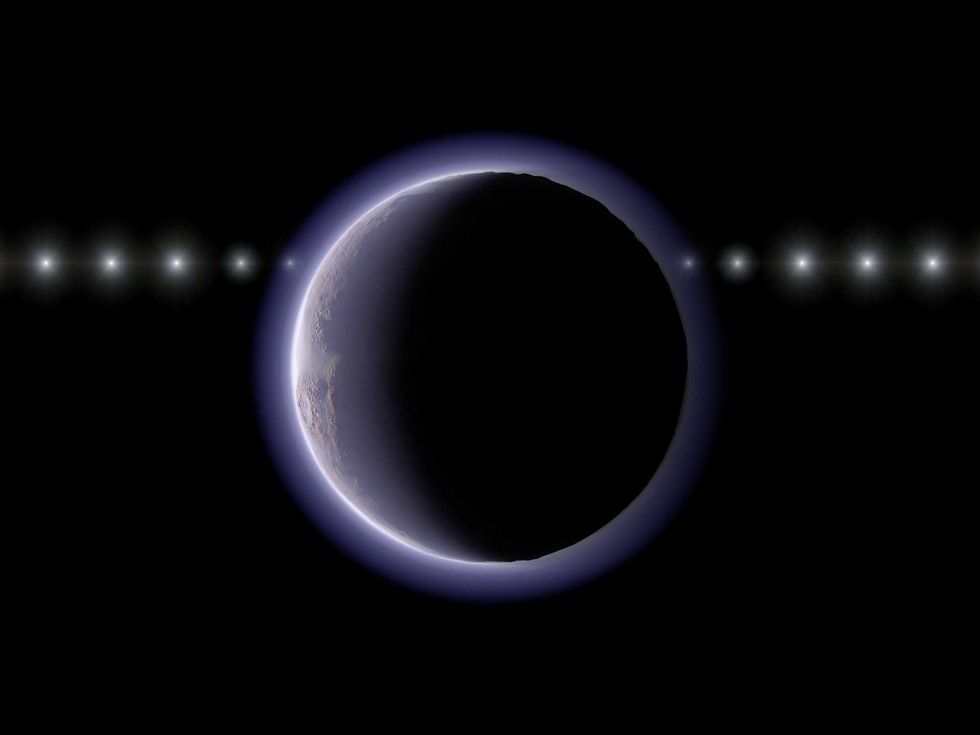 This image provided by NAOJ shows artist’s impression of the trans-Neptunian object (612533) 2002 XV93 occulting a background star. Observations of a stellar occultation in January 2024 revealed gradual fading and recovery of the starlight, providing evidence for a very thin atmosphere around the object Ko Arimatsu/NAOJ via AP)
Formally designated (612533) 2002 XV93, this minor planet is classified as a plutino, completing two orbits around the sun for every three Neptune completes. At the time of the study, it was situated more than 3.4 billion miles (5.5 billion kilometres) away, surpassing even Pluto in distance, which is the only other Kuiper Belt object known to have an atmosphere.
The cosmic iceball's atmosphere is estimated to be astonishingly thin – between 5 million and 10 million times less dense than Earth’s protective atmospheric layer. It is also 50 to 100 times thinner than Pluto’s already tenuous atmosphere. The most probable chemical constituents are methane, nitrogen, or carbon monoxide, any of which could account for the observed stellar dimming, according to Mr Arimatsu.
Further observations, particularly from NASA’s advanced Webb Space Telescope, will be crucial to verify the atmosphere's precise composition. "That is why future monitoring is so important," Mr Arimatsu emphasised. He explained that if the atmosphere dissipates over the coming years, it would support an impact origin. Conversely, if it persists or fluctuates seasonally, it would point towards an ongoing internal gas supply, possibly from ice volcanoes.
Top 100