The Conversation (0)
President Trump threatens funding cuts over sanctuary policies
Fox - 26 Houston / VideoElephant
One of the world's most ambitious ocean monitoring networks is facing a significant shutdown, with scientists preparing to dismantle a crucial research buoy off the Oregon coast this month.
This marks the beginning of a broader "descoping" of the Ocean Observatories Initiative (OOI), a vital system that has provided real-time data on the Pacific for over a decade.
On 16 June, a buoy situated 80 metres (260 feet) beneath the surface will be retrieved, signalling the start of the OOI's partial closure. This extensive network, comprising over 900 ocean sensors, was constructed at a cost of $386 million and has continuously gathered real-time data for more than ten years.
Last month, the National Science Foundation (NSF) confirmed plans to dismantle the majority of the system, with instruments to be removed from waters near Oregon, Washington, Alaska, North Carolina, and Greenland by 2027.
The observatories, funded by the NSF, have been instrumental in monitoring ocean circulation, marine ecosystems, climate change, and extreme weather. Its freely accessible data has contributed to over 500 scientific publications.
Despite being initially planned for another 15 to 20 years of operation, the NSF stated in an email that the decision is not a "cancellation" but a "descoping."
This, they claim, aligns with a "wider strategy of a nimbler approach to prioritize support for evolving scientific priorities and emerging technologies, as well as smart lifecycle management within its research infrastructure portfolio." The foundation also cited a forthcoming 2025 National Academies report on the future of ocean science as a partial basis for their decision.
However, for the scientists, researchers, educators, and students who depend on the OOI's invaluable data, the timing of this shutdown is particularly concerning.
This summer, an El Niño event, known for disrupting weather patterns and intensifying marine heatwaves, is forecast to impact the Pacific coast. Already, an unusual marine heatwave is causing warmer-than-average waters off California.
The removal of the Oregon and Washington moorings, alongside the OOI's network of underwater gliders in the region, will severely diminish researchers' capacity to monitor subsurface ocean activity – precisely where critical oceanographic signals originate.
Ed Dever, a professor at Oregon State University who co-led the initiative’s Pacific Northwest operations, described it as "a crippling loss of information." While some surface data, such as temperature and chlorophyll distribution, can be obtained, crucial information from below the surface, including low oxygen zones, cannot be solely gathered by satellites.
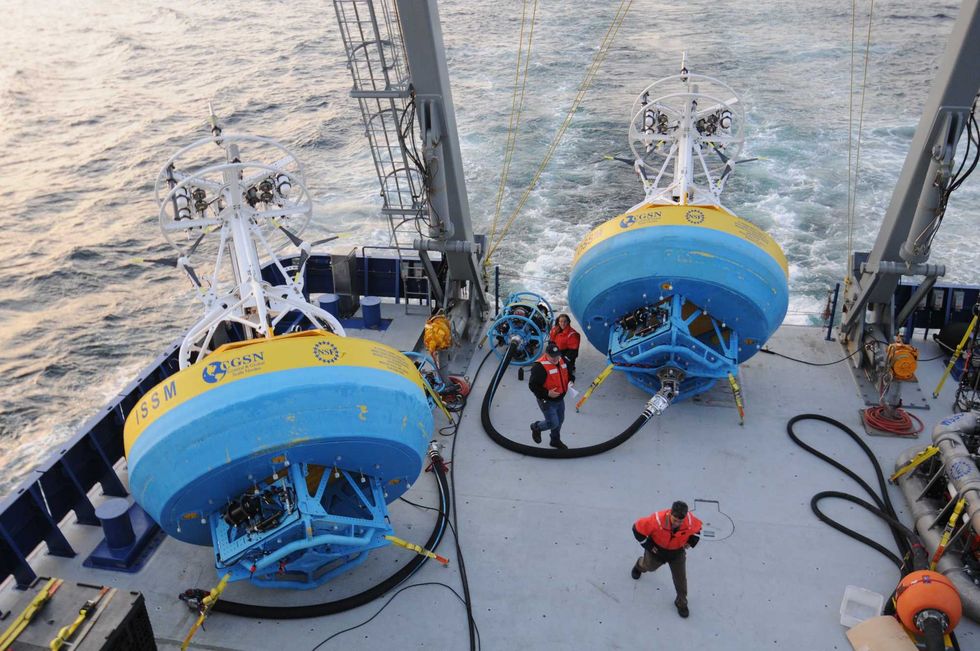 In this 2021 image provided by Woods Hole Oceanographic Institution, workers walk near buoys used to gather data at Pioneer New England shelf off the coast of Martha’s Vineyard, Mass.Véronique LaCapra/Woods Hole Oceanographic Institution via AP
The initiative, launched in 2015 following over a decade of planning and construction, was conceived as a 25 to 30-year endeavour.
This duration was based on the oceanographic consensus that at least three decades of continuous data are necessary to detect meaningful climate signals. "We’ve just got to the 10 year record," Dever noted, "which will give you some hints, but it won’t continue on."
A single significant component will endure: a seafloor cable network managed by the University of Washington off the Pacific Northwest coast, which will continue to supply data on regional volcanic and seismic activity.
Scientists had anticipated these cuts, noting that the Trump administration’s proposed 2026 budget included a 55 per cent reduction for the science foundation. The official directive to commence the shutdown arrived in early May.
The OOI was coordinated by the Woods Hole Oceanographic Institution, in partnership with the University of Washington and Oregon State University, alongside former collaborators such as Rutgers University and Scripps Institution of Oceanography.
Operating on approximately $48 million annually, excluding the substantial cost of research vessels, the project employed 60 to 70 individuals across its partner institutions before budget cuts began in 2025.
Dever warned, "What’s happening with the Ocean Observatories Initiative is not unique. This is just one of a number of science facilities that is being dismantled at the present time. It seems to really mark the end of a federal commitment to basic scientific research — a commitment that has served this nation very well for the last 70 years."
Top 100