The Conversation (0)

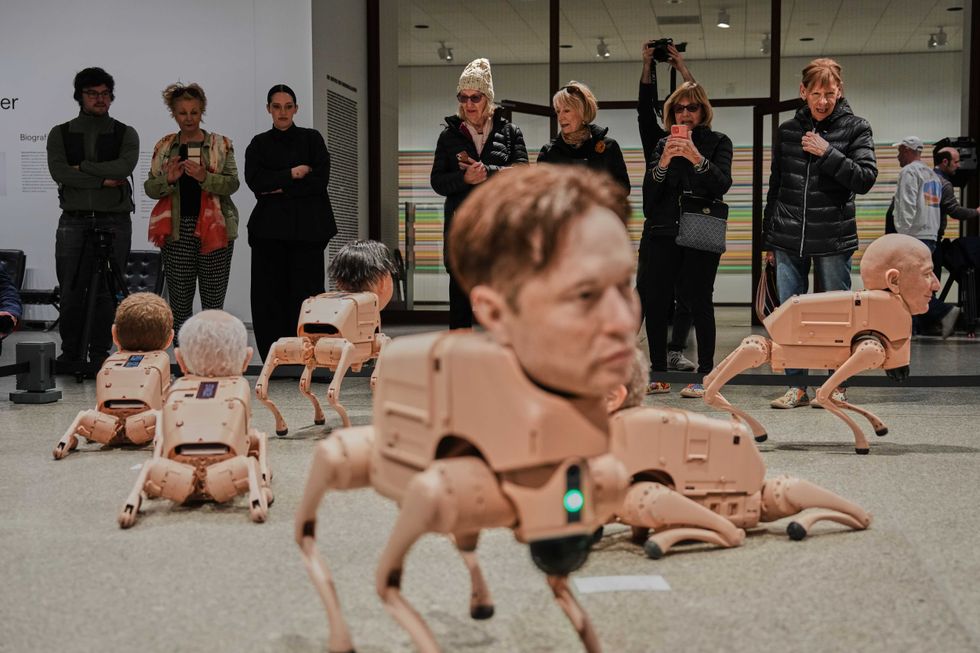
Artist Beeple, Mike Winkelmann, poses inside his installation titled Regular Animals, with robots in the likeness of Kim Jong Un, left, Elon Musk, second left, Kim Jong Un, Jeff Bezos, center, and Mark Zuckerberg, right, at the Neue Nationalgalerie museum in Berlin
AP Photo/Markus Schreiber
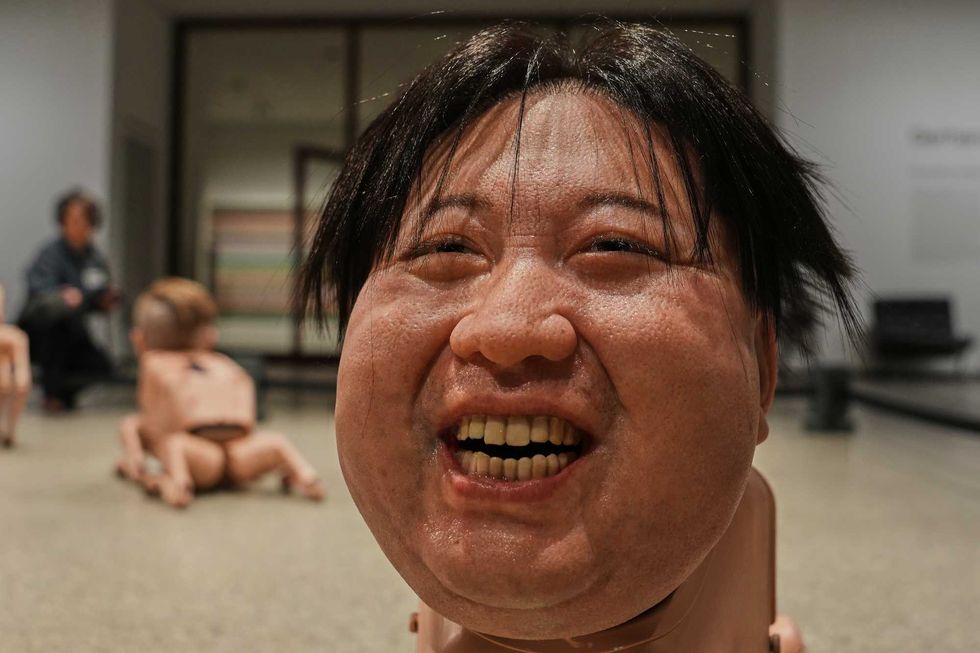
Robot dogs, adorned with hyper-realistic silicone heads modelled after global figures such as Elon Musk, Mark Zuckerberg, Jeff Bezos, Andy Warhol, and Pablo Picasso, are currently roaming a Berlin gallery. These mechanical canines occasionally "poo" printed images of their surroundings, captured by integrated cameras and transformed by artificial intelligence.
The interactive installation, titled "Regular Animals," is the brainchild of American artist Beeple (Mike Winkelmann) and is on display at Berlin's New National Gallery. Each printed image offers a glimpse of reality, reshaped by AI to reflect the personality of the dog, or rather, the worldview of the human figure it embodies. For instance, the Picasso dog generates images in a Cubist style, while Warhol’s produces pop art.
This provocative display serves as a commentary on how our perceptions are increasingly shaped by algorithms and technology platforms, according to the exhibition organisers. Beeple explained to the AP: "In the past, our view of the world was shaped in part by how artists saw the world. How Picasso painted changed how we saw the world, how Warhol talked about consumerism, pop culture, that changed how he saw those things."
 AP Photo/Markus Schreiber
He added that today, our worldview is dictated by tech billionaires who control powerful algorithms, determining what information we consume. "That's an immense amount of power that I don’t think we’ve fully understood, especially because when they want to make a change, they don’t need to lobby the U.N. They don’t need to get something through Congress or the EU, they just wake up and change these algorithms." Some of the robot dogs also feature heads in Beeple’s own image.
Lisa Botti, the exhibition’s curator, highlighted artificial intelligence as one of the most impactful phenomena of our time, asserting that "museums are the places where society can reflect" on such transformations, which motivated her to showcase Beeple’s work. The installation first premiered at Art Basel Miami Beach 2025.
Beeple, a graphic designer from South Carolina, is renowned for his diverse digital artwork and is a pioneer of the "everyday" movement in 3D graphics, having consistently created and posted a new image online daily for years. Christie's ranks him as the third most expensive living artist to sell at auction, trailing only David Hockney and Jeff Koons.
 AP Photo/Markus Schreiber
In spring 2021, Christie’s facilitated the sale of Beeple's digital collage, "Everydays: The First 5000 Days," which fetched over \$69 million. The auction house described the artwork as "critiques of modern society, the government and social media" presented through "grotesque, dystopian futures, often featuring celebrities like Donald Trump and Kanye West." This landmark sale marked the first time a major auction house offered a digital-only artwork with a non-fungible token (NFT) as a guarantee of authenticity, and the first instance of cryptocurrency being used for an artwork purchase at auction. NFTs, electronic identifiers confirming the authenticity of digital collectibles via a blockchain ledger, have recently surged in popularity, mirroring the boom in cryptocurrencies.
At the Art Basel 2025 event, Beeple distributed the "pooed" photographs to attendees, each accompanied by a certificate proclaiming "100% organic GMO-free dog s**t." Some prints included QR codes providing access to free NFTs, effectively allowing Beeple to give away his digital art for potential monetisation by the recipients, who were sometimes the subjects of the photos themselves.
Top 100