The Conversation (0)
Heatwave: Which European countries are running out of water?
Euronews Europe / VideoElephant
Basel, Switzerland, witnessed an unusual spectacle this weekend as yodelers participating in a national festival sought refuge and rehearsal space in the city’s public fountains, battling Europe’s intense June heatwave. The impromptu aquatic practice sessions became a defining image of the Eidgenössisches Jodlerfest, as temperatures soared to a record-breaking 39 degrees Celsius.
Throughout the city, from Friday to Sunday, the streets resonated with the distinctive sounds of singers and alphorn players. Folk bands dipped their toes in the cool water of fountains, while festivalgoers clapped along or simply cooled their hands. Spontaneous bursts of yodeling echoed through restaurants, initially surprising diners before encouraging them to join in the festive atmosphere. Even seamstresses were on standby in Petersplatz, ready to mend the traditional Alpine folk costumes worn by participants.
This year’s festival, which drew approximately 12,000 performers and nearly 200,000 visitors, marked the first time Basel had hosted the national yodeling event since 1924. It also held particular significance as the first national gathering since Swiss yodeling was added to UNESCO’s Representative List of the Intangible Cultural Heritage of Humanity in December 2025 – a distinction that fills many Swiss with pride.
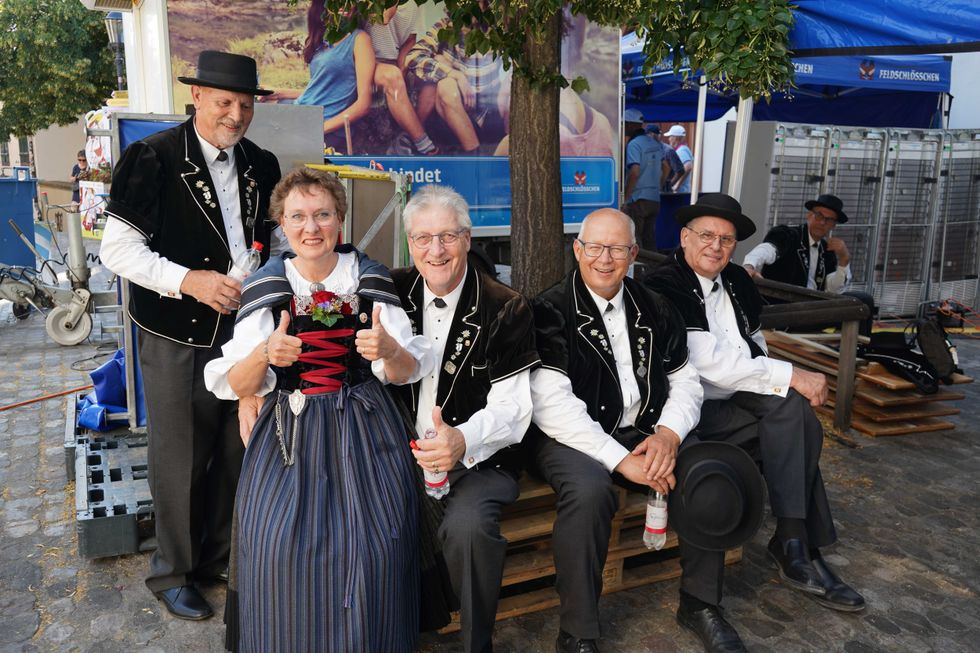 A group of yodellers stay cool in the shade outside the Martins church in Basel, Switzerland, Saturday, June 27, 2026AP Photo/Jez Fielder
Unlike the brighter, more melodic style often associated with Austria, Swiss yodeling is characterised by its slower, more melancholic tone, deeply rooted in distinct regional dialects and emotional nuance. Freddie Conquer, a member of Jodlerclub Echo Basel, one of the host clubs, shared his personal connection: "I’ve always loved music, and I left here as a child. When I moved back to New Zealand, I wanted to stay connected to Swiss culture, so I joined a New Zealand-Swiss-Kiwi yodeling club."
The festival featured competitions across three disciplines: yodeling, alphorn playing, and flag-throwing. The alphorn, a long wooden instrument traditionally used by herdsmen, can stretch over three metres, its sound carrying across valleys and, during the festival, through Basel’s urban landscape. Pierre-André Karlen, rehearsing on a school lawn, explained its unique mechanics: "Everything is down to the mouthpiece, hearing the note in your head, and then using your lips to shape the pitch. The higher the note, the harder you have to blow."
On Sunday morning, anticipation filled the air as participants gathered outside the town hall for the competition results. Members of Jodlerklub Balfrin, from Visp, celebrated loudly after achieving a perfect score, one of several teams to do so. The festival concluded with a vibrant closing parade through the old town, featuring flags, Jodlerklub Muttenz members riding past on a tractor to cheers, and alphorn players whose instruments and costumes, though undoubtedly heavy in the heat, were accompanied by unwavering smiles.
Top 100