The Conversation (0)
Scientists agree, greenhouse gases cause of climate change
USA Today - Vertical / VideoElephant
The United States is currently grappling with, or on the cusp of experiencing, a barrage of extreme weather events stretching across nearly its entire expanse. From torrential downpours in Hawaii to scorching heat in the Southwest, and from heavy snowfall in the Great Lakes to an Arctic chill gripping the Midwest and East, the nation faces a period of widespread meteorological volatility.
This forecast of widespread extremes follows a dramatic "weather whiplash" that has already affected much of the East Coast. Washington, D.C., for instance, saw residents enjoying record-breaking temperatures of 30 degrees Celsius in shorts on Wednesday, only for snow to fall the very next day.
"All of the country, even if you’re not necessarily seeing extremes, are going to see generally changing from cold to warm, or warm to cold to warm," explained Marc Chenard, a meteorologist from the weather service’s Weather Prediction Center in Maryland. Ryan Maue, a former chief scientist at the National Oceanic and Atmospheric Administration, echoed this sentiment, stating he anticipates extreme weather across all 50 states.
Early next week, a significant heat dome is predicted to settle over the Southwest, pushing temperatures into triple digits not typically observed so early in the year. Phoenix, Arizona, is forecast to reach 37 degrees Celsius on Tuesday, followed by consecutive days of 39, 41, and two days of 42 degrees Celsius. Historically, Phoenix has never hit 38 degrees Celsius before March 26 in 137 years of record-keeping, usually reaching its first 38-degree day in early May.
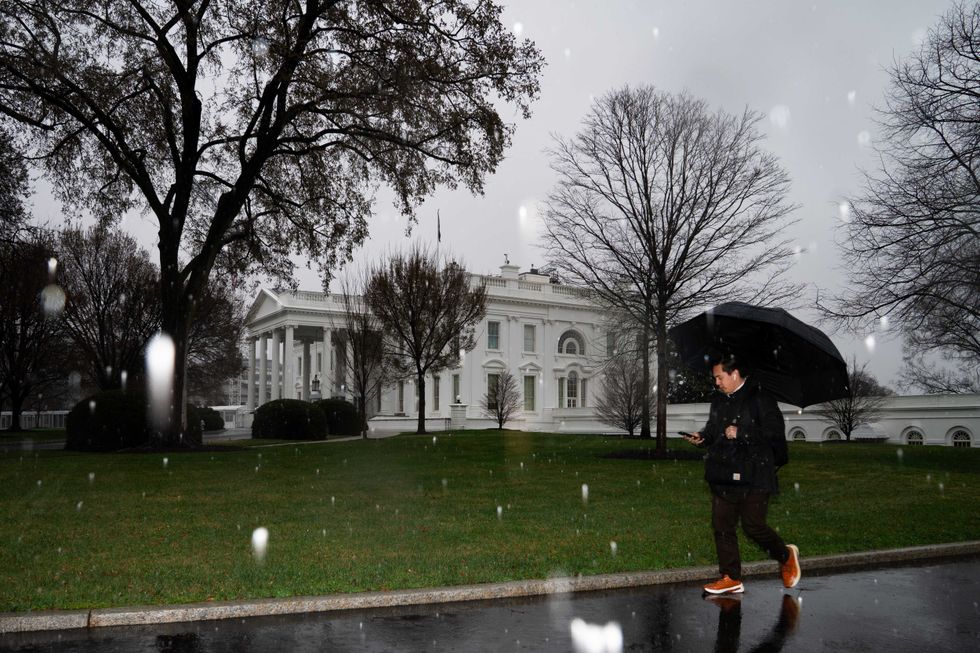 A person walks through falling snow at the White House on Thursday, March 12, 2026, in WashingtonAP Photo/Allison Robbert
The weather service has issued a warning: "Since we are not acclimated to this level of heat this early in the year, it will be more impactful than usual." Los Angeles has already experienced unusual 32-degree Celsius March weather, forcing people to seek shade. Shane Dixon, 40, from Culver City, described his Thursday run as difficult due to the heat, saying, "The back of my neck was melting." He added, "I could go literally soak myself and walk out in the sun and I’ll make it home fine. If it was freezing cold I could not do this."
Conversely, as the Southwest bakes, the polar vortex – a system that typically confines frigid air near the North Pole – is expected to plunge deep into the Midwest and East, even touching parts of the Southeast. Minneapolis is set to hover around zero degrees Celsius, with Chicago experiencing single-digit temperatures on Tuesday. The following day, "temperatures in the teens and 20s in the northeast and 20s in the Mid-Atlantic," according to Mr Maue, with Atlanta potentially dropping to below zero.
Adding to the meteorological chaos, two successive storm systems are poised to dump significant snowfall across the country's northern tier and Great Lakes region. The first is expected on Friday, followed by a more potent system from Sunday into Monday, which together could deliver between 90 and 120 centimetres of snow in some areas. The second, larger storm is anticipated to intensify so rapidly and sharply – a phenomenon known as a bomb cyclone – that it will be highly unusual for developing over land. Typically, bomb cyclones draw energy from warm ocean waters, but this one will be powered by the polar vortex.
Even the extremities of Alaska and Hawaii are not immune. Hawaii is bracing for an atmospheric river bringing persistent heavy rain and significant flooding, with Oahu already under a flash flood warning. Alaska, usually frigid at this time of year, is forecast to be about 30 degrees colder than usual.
 Construction workers spray water during an unseasonably hot day at MacArthur Park on Thursday, Mar. 12, 2026 in Los Angeles. AP Photo/Ryan Sun
"It is the time of year where we can see stuff like this," Mr Chenard noted, "But this does seem even anomalous from what you would typically see. I mean, some of these areas will be setting records. Record-high temperatures for March and maybe multiple times." This comes after tornadoes killed at least eight people in Oklahoma, Michigan, and Indiana in the past week. While the forecast for severe storms is not as widespread for the coming week, dangerous thunderstorms could emerge "anywhere from the Mississippi Valley toward the East Coast" on Sunday or Monday.
Underpinning this erratic weather is a "jet stream gone wild," as described by Mr Maue and Mr Chenard. The jet stream, a high-altitude river of air that guides weather patterns from west to east, is typically a gentle roller-coaster. However, it is now exhibiting "scream-inducing drops" followed by "straight-up ascents," creating extreme contrasts. Mr Maue explained that storm fronts from the Pacific are being pushed north by the high-pressure heat dome in the Southwest, climbing the jet stream's "mountainous peak" to "grab access to that cold air reservoir up there" before bringing it back down south down the other side of the hill.
 People cover themselves from the heat with umbrellas while waiting at a food distribution site Wednesday, March 11, 2026, in Los AngelesAP Photo/Damian Dovarganes
Numerous studies have drawn connections between unusual jet stream and polar vortex activity and the shrinking of Arctic sea ice, linking these phenomena to human-caused climate change.
Despite the grim outlook, Mr Maue offered a glimmer of hope: "The first day of spring is 20th (of March), and then after that we get recovery."
Top 100