The Conversation (0)
Trump slams Germany’s Merz again as rift over war on Iran widens
Aljazeera / VideoElephant
Donald Trump has issued a fresh warning to Germany, a key Nato ally, suggesting a potential reduction in the US military presence there amid an escalating feud with Chancellor Friedrich Merz over the US-Israel war against Iran.
The threat follows Mr Merz’s earlier comments this week, where he stated that the US was being "humiliated" by the Iranian leadership and criticised Washington’s perceived lack of strategy in the conflict. Mr Trump has also consistently expressed frustration with Nato for its refusal to assist the US in the two-month-old war.
In a social media post, Mr Trump declared: "The United States is studying and reviewing the possible reduction of Troops in Germany, with a determination to be made over the next short period of time."
Earlier on Wednesday, Mr Merz had maintained that his personal relationship with Mr Trump remained "as good as ever," but admitted he "had doubts from the very beginning about what was started there with the war in Iran."
During his time in the White House, Mr Trump previously sought to cut US troops in Germany, arguing the country was not spending enough on defence. In June 2020, he announced plans to withdraw approximately 9,500 of the roughly 34,500 US troops then stationed in Germany, though this process never commenced. Democratic President Joe Biden formally halted the proposed withdrawal shortly after taking office in 2021.
Germany hosts several crucial US military installations, including the headquarters for US European Command and US Africa Command, Ramstein Air Base, and Landstuhl Regional Medical Center, which is the largest American hospital outside the United States.
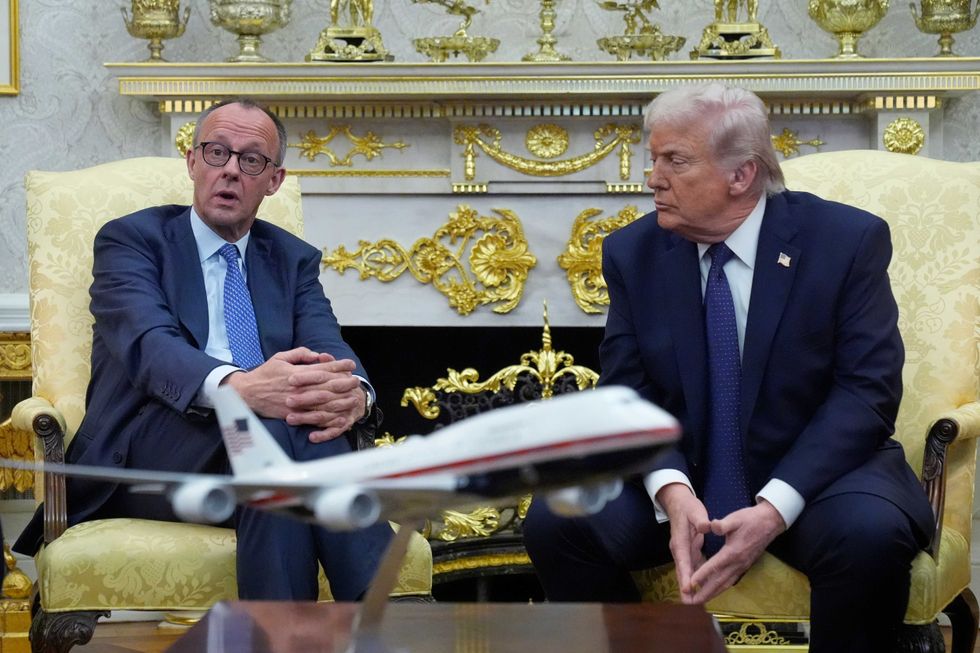 President Donald Trump meets with German Chancellor Friedrich Merz in the Oval Office at the White House, March 3, 2026, in Washington AP Photo/Mark Schiefelbein, File
Mr Merz met Mr Trump at the White House in March, just days after the US and Israel initiated their bombardment of Iran. At the time, Mr Merz conveyed Germany’s eagerness to collaborate with the US on a strategy for a post-Iranian government scenario. He also voiced concerns that a prolonged conflict could severely damage the global economy.
These concerns, shared by many European leaders, have intensified as the US and Iran have yet to agree on reopening the Strait of Hormuz. This vital waterway, through which about 20 per cent of the world’s global oil supply flowed before the war, has been effectively closed since the conflict began on 28 February.
"We are suffering considerably in Germany and in Europe from the consequences of, for example, the closure of the Strait of Hormuz," Mr Merz stated on Wednesday, hours before Mr Trump’s social media post. "And in that regard, I urge that this conflict be resolved." He added that his government was "on good speaking terms" with the Trump administration.
Mr Trump, however, has made little effort to conceal his exasperation with Mr Merz. On Tuesday, he wrote: "The Chancellor of Germany, Friedrich Merz, thinks it’s OK for Iran to have a Nuclear Weapon. He doesn’t know what he’s talking about!" Mr Trump further remarked that it was no surprise "that Germany is doing so poorly, both economically and in other respects!"
Top 100