The Conversation (0)
Related: The New Workday: Productivity Without Hustle Culture
Solution Tales - Lifestyle Now / VideoElephant
Before the household stirs and her teenagers request breakfast or a lift to school, Jen Meegan is already immersed in her company emails, refining ideas she sketched out the previous evening.
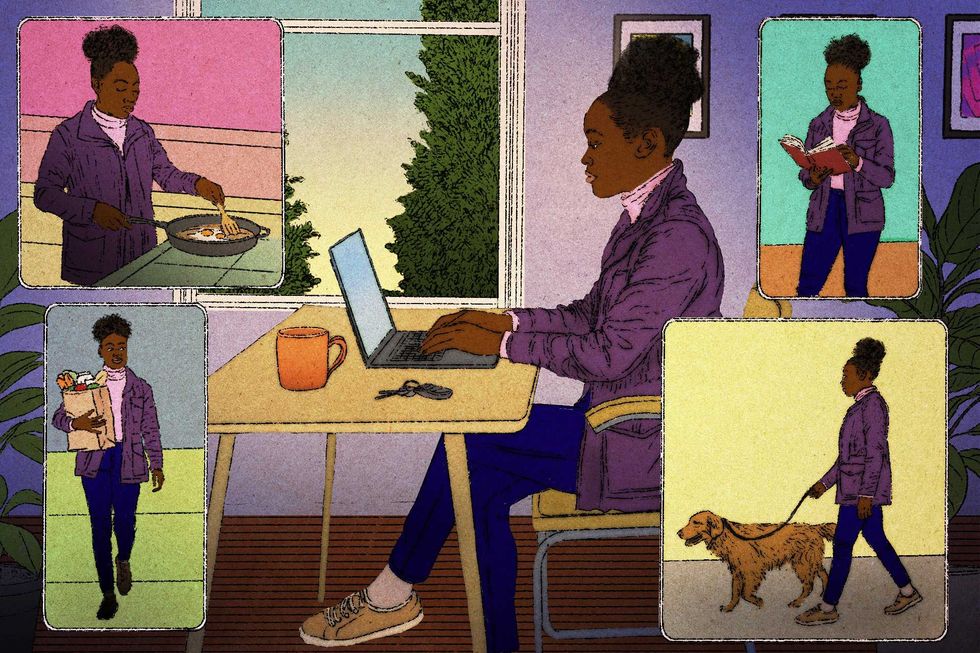
She dedicates an hour or so to work, then, following the school run, she might shop for groceries or fill up her car before returning to her role as head writer and co-founder of Sheer Havoc, a creative services agency. This pattern defines her day: focused work in short bursts, interspersed with an hour or two dedicated to family and personal commitments, a rhythm she maintains until late at night.
Meegan exemplifies a growing trend among employees known as "microshifting" – a flexible scheduling approach where job responsibilities are tackled in short, productive intervals rather than a continuous nine-to-five stretch. This method allows paid work to be woven around and between non-work obligations and priorities. Performance is primarily assessed by output, with less emphasis placed on the sheer number of hours spent in front of a screen.
"Sometimes the break’s when most of the work will get done in your head, because you’re not sitting in front of a laptop just staring at a screen going, ‘I can’t come up with anything,’" Meegan explained.
This practice is gaining traction amongst workers and is increasingly accepted by some organisations as a means to enhance work-life balance. The widespread adoption of remote and hybrid working models during the coronavirus pandemic left many yearning for dedicated time to care for themselves or others, particularly as return-to-office mandates began to emerge.
"As more managers and more organisations get better adept at giving a little bit of autonomy, this is becoming not only a little more popular, but it also gives employees the motivation and almost the license to ask for this," noted Kevin Rockmann, a professor of management at George Mason University's Costello College of Business.
Whilst independent contractors have long embraced such flexible working, the term "microshifting" is now resonating with those in roles traditionally demanding fixed, consecutive hours. Some companies are actively offering this flexibility, or at least acknowledging that employees are adopting this method even if it isn't explicitly sanctioned.
Advocates argue that working in increments significantly boosts productivity by allowing the brain essential breaks. Taking a walk or attending a child’s school event can be profoundly re-energising for individuals who find prolonged desk work or screen time draining, proponents suggest.
"From a creativity standpoint, it’s good to take breaks," Professor Rockmann affirmed. "When you stop thinking about a task is when your best ideas come to you."
Shellie Garrett, who led an eight-person team as director of investigations and appeals at Oklahoma Community Cares Partners – an entity established to verify rental assistance claims during the pandemic – allowed her staff to set their own schedules, with the exception of weekly team meetings.
 AP Illustration / Peter Hamlin
"Everybody needed to maintain availability for emergency questions or issues. But I let people determine what worked best for them productivity-wise," Garrett said. "If productivity was lapsing, we had to figure out different solutions. But overall, I feel like giving that autonomy led to better production and happier employees."
During their working hours, her team members updated spreadsheets, cross-referenced documents, or conducted investigative work. In their off-hours, one employee was nursing an infant and homeschooling a preschooler, whilst another managed a second job as a real estate agent.
Amanda Elyse, a full-time professor of legal writing at Seattle University School of Law and a part-time policy and programmes lead at the Northwest Animal Rights Network, finds that microshifting enables her to share meals with her partner, who works nights, and to spend time with her dogs during the day.
"There’s just so many little things in the day that, when you’re in control of your schedule, you can take that time to do," Elyse commented.
However, whilst microshifting often benefits personal relationships, it can sometimes strain professional ones, Professor Rockmann cautioned. Effective teams thrive on collaborative work, but "the whole idea of microshifting is taking care of yourself," he explained. "It's not that taking care of yourself is bad. It places the emphasis on the individual, not the relationships."
Pranav Dalal, the founder and CEO of California-based remote staffing firm Office Beacon, manages employees across India, the Philippines, Mexico, and South Africa, who work for American companies in sectors such as customer service, finance, and logistics. Dalal is aware that some employees are microshifting to manage personal needs.
"It’s happening without a policy and without me saying it, and those are in positions where they’re more managerial positions," he stated. "I don’t really question it because I know that people are getting their work done at those levels."
As a single father, Dalal understands the need for flexibility. Yet, he acknowledges instances where this freedom can be abused. When one team member consistently arrived late to in-person work events due to personal commitments, it caused problems, leading Dalal to dismiss the employee.
"If someone really abuses that, it becomes destructive to the team because then resentment builds," Dalal added. "As an employer, it definitely is a big shift for companies. And the shift is, essentially, can you deliver the same quality service, reliably, when there’s microshifting happening?"
For Isabelle "Izzy" Young, a political organiser in Texas, her demanding role allows her to largely choose her own hours, provided the work gets done. This ability to self-schedule is crucial for Young, who manages autism and a chronic illness called postural orthostatic tachycardia syndrome, which can cause a rapid heart rate or dizziness upon standing. If she requires more sleep, she can schedule meetings later in the day. If she needs to reset her nervous system, she can take an hour or two midday to call a friend or read a book before resuming work in the evening.
"I am very lucky to have a principal that is a compassionate person," Young said. "He’s acutely aware that life happens, and you can be incredibly productive and chronically ill." One drawback, she admits, is the pervasive feeling of always being at work. "The job never ends, so you’re never really off the clock."
Garrett, the team leader in Oklahoma, found working in two-hour blocks invaluable for managing the fluctuations of chronic conditions, including an autoimmune disease and premenstrual dysphoric disorder. This allowed her to experience bursts of creativity, followed by a nap or a trip to the gym.
"Microshifting was honestly a godsend," Garrett reflected. "I don’t know if I could have done this job without being able to do that."
When seeking flexibility from an employer, Garrett advises focusing on the benefits for the company. "You have to go into the interview and sell it," she suggested. "You have go in and say, ‘I’m willing to do whatever schedule and put my best foot forward, but if you want me to be most productive or most creative, this is how I work best, if this is something you’re willing to work with.’"
Top 100