The Conversation (0)
Only a true master of the English language can pronounce all the words in this poem (we tried)
content.jwplatform.com
A team of Irish researchers has unearthed what they believe to be the oldest surviving English poem, a remarkable discovery made while poring over a medieval manuscript in a Roman library. Flipping through its digitised pages, the academics from Trinity College Dublin found their long-sought treasure, sparking astonishment.
"We were extremely surprised. We were speechless. We couldn’t believe our eyes when we first saw that," Elisabetta Magnanti, a visiting research fellow at Trinity College Dublin's school of English, told The Associated Press. She added that the poem’s placement within the main body of the Latin text was "extraordinary."
The poem, "Caedmon’s Hymn," composed in Old English by a Northumbrian agricultural worker in the 7th century, appears within certain copies of the "Ecclesiastical History of the English People." This seminal work was written in Latin by the Venerable Bede, a monk and saint. Bede’s history is one of the most widely reproduced texts from the Middle Ages, with nearly 200 manuscripts known, according to Magnanti’s colleague, Mark Faulkner, an associate professor of medieval literature at Trinity.
Professor Faulkner considers Caedmon’s poem to be the very genesis of English literature. The manuscript discovered by him and Ms Magnanti dates from the 9th century, making it one of the oldest. While two earlier copies contain the poem in Old English, these were merely afterthoughts – translated from Latin and scrawled into the margin or appended, rather than integrated into the main text, researchers noted.
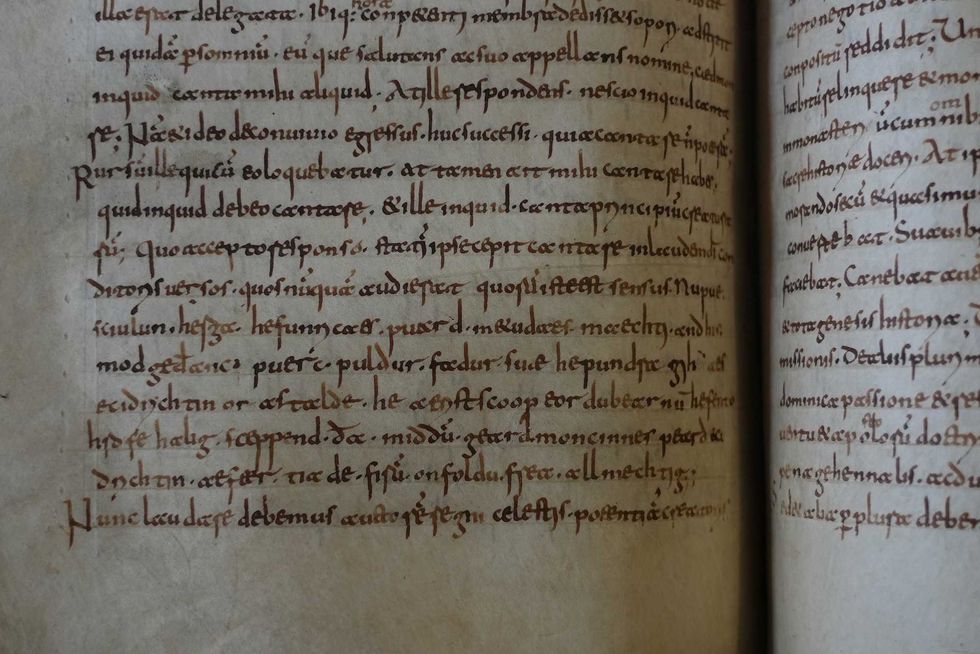 A rare, long-lost copy of Caedmon's Hymn — the first poem ever written down in Old English — is visible in the five lines above the final line of a page from an 8th-century manuscript copy of the Venerable Bede's Ecclesiastical History of the English PeopleAP Photo/Andrea Rosa
This significant find illuminates the widespread diffusion of the English language far earlier than previously understood, Professor Faulkner explained from Rome, where the duo had travelled to examine the text in person.
"Prior to the discovery of the Rome manuscript, the earliest one was from the early 12th century. So this is three centuries earlier than that. And so it attests to the importance that was already being attached to the English in the early 9th century," Professor Faulkner stated. The fact they uncovered it at all is considered something of a miracle.
The book itself boasts a long and convoluted history. Caedmon is said to have composed the nine-line hymn while working at Whitby Abbey in North Yorkshire. After guests at a feast began reciting poems, Caedmon, "embarrassed that he didn’t know anything suitable, left the feast and went to bed," Professor Faulkner recounted. "A figure then appeared to him in his dreams telling him to sing about creation, which Caedmon miraculously did."
Some 1,400 years later, this particular copy of his poem resurfaced in Rome’s main public library, but not before traversing the Atlantic Ocean at least twice and changing hands numerous times. Monks at the Benedictine abbey of Nonantola, a crucial transcription centre near modern-day Modena in northern Italy, transcribed this copy of Bede’s history.
Valentina Longo, curator of medieval and modern manuscripts at Rome's National Central Library, explained that as the abbey’s importance waned in the 17th century, its vast collection was moved to another Roman abbey, then to the Vatican, and finally to a small church. Along the way, some texts vanished, only to reappear in the early 19th century in the possession of renowned international collectors.
This copy of Bede’s history eventually reached the famous English antiquarian Thomas Phillipps. Facing financial hardship, Phillipps sold off parts of his collection, and the book was acquired by Swiss bibliophile Martin Bodmer. From there, it somehow made its way to New York City, into the trove of Austrian-born rare bookseller H.P. Kraus during the 20th century.
Italy’s culture ministry, actively searching the world for Nonantola Abbey’s missing manuscripts, purchased the copy of Bede’s history from Kraus in 1972. Since then, the illustrious text has resided in Rome’s library, largely unnoticed.
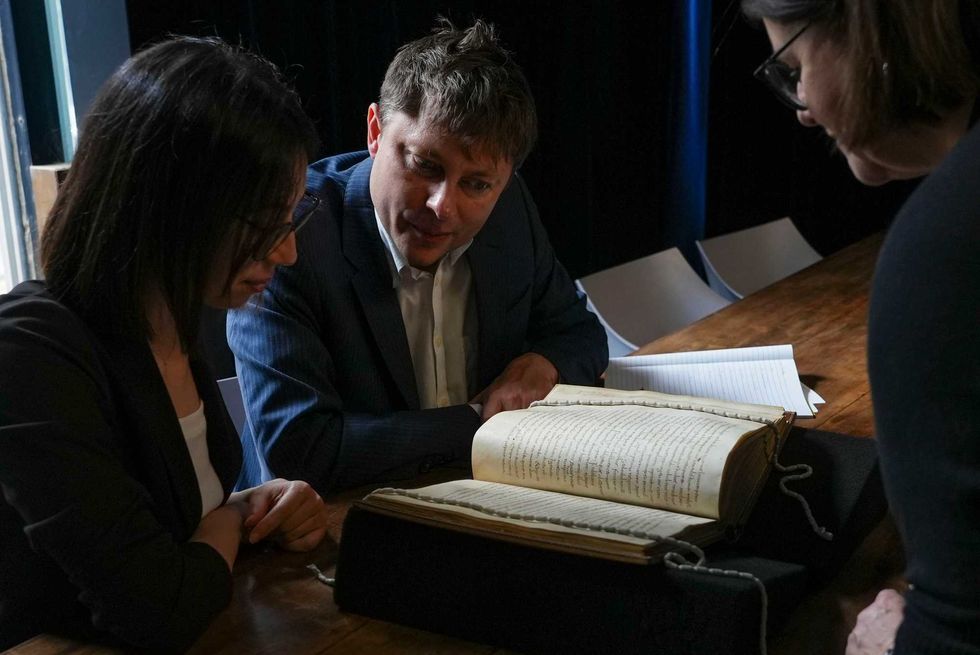 From left, Elisabetta Magnanti and Mark Faulkner from Dublin's Trinity College and Valentina Longo of Rome's National Central Library look at a manuscript containing a rare, long-lost copy of Caedmon's Hymn, the first poem ever to be written down in Old English, at Rome's National Library AP Photo/Andrea Rosa
Enter Ms Magnanti, who had spent over four years studying Bede’s history and was compiling a catalogue of extant copies. "I knew that the book was listed in the library’s catalog, so I was almost certain that the book was, in fact, still here," she said. "I realised that, because of the very complex history of this book, no Bede scholar had really looked at it. So it had been virtually unstudied." She emailed the library, which confirmed its presence, and three months later, she received digital images of the entire manuscript.
The text of the poem in Old English: Nupue. sciulun. herga. hefunricaes. puard. metudaes. maechti. and his. mod geðanc. puerc. puldur. fadur. suæhepundragiaes ecidrichtin or astalde. he aeristscoop eor dubearnū hefento hrofe halig. sceppend. ða. middū. geard. moncinnes peard eci drichtin. aefter. tia de. firū. on foldu. frea. allmechtig.
The text of the poem translated into modern English: Now we must praise the guardian of the heavenly kingdom, the might of the creator and his intention, the work of the father of glory, in that he of each wonder, eternal lord, established the beginning. He first created the earth for men, heaven as a roof, the holy creator, then the middle earth, the guardian of mankind, the eternal lord, afterwards created for men on earth, the almighty lord.
The library is now making more of its rare books available. Ms Longo confirmed that the entire Nonantolan collection has been digitised and is freely accessible online. This forms part of a broader initiative by the library to make thousands of rare books and manuscripts available to researchers globally, according to Andrea Cappa, the library’s head of manuscripts and the rare books reading room.
"The discovery made by the experts of Trinity College is just one starting point, a single manuscript that might pave the way for countless other discoveries, in countless other fields, through international cooperation like this," Mr Cappa concluded.
Top 100